
How politics, misinformation, and governance failures are driving wolf persecution in the Netherlands
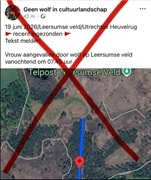
broodjeaapverhaal
(tall tale, urban myth)
Political actors, officials, and aligned organisations in the Netherlands have created a hostile, fear‑driven environment around wolves. Media stories about wolf attacks or threats are often exaggerated or false, yet amplified by anti‑wolf groups. Weak livestock‑protection rules create perverse incentives. Illegal killing is widespread. The illegal killing of Bram, a "problem wolf” reveals systemic failures in governance and accountability
In one of his very last actions as State Secretary in the Netherlands for Agriculture, Fisheries, Food Security and Nature, Jean Rummenie was reported in February to have discussed with Belgium and Luxembourg about requesting a special exemption from the European Commission concerning wolf populations - "We are three densely populated and sparsely forested countries. The question is whether we should meet the same criteria as the other countries" (1). Rummenie believed that the Benelux countries should push for a more centrally managed European wolf policy – "It's odd that each country has to individually determine how their wolf populations should survive. The European Commission should be more proactive in ensuring a logical distribution across the countries"
Rummenie, Boitani, and the Benelux special exemption narrative
I see Luigi Botaini, an Italian wolf expert who normalises lethal control of wolves (2) as being responsible for this nonsense of allegedly considering approaching the EC together to plead to be special cases in terms of wolf populations. This will take some explaining. Last year, Rummenie had dismissed a report he had commissioned that had set the favourable wolf population in the Netherlands at between 23-56 packs, and announced that he was seeking an additional investigation to be carried out (2). Jo Brouns, the Flemish Minister for the Environment and Agriculture, was reported last August to have called for an assessment of the maximum number of wolves that Flanders could support, claiming “we must remove the rest, and kill them if there is no other option.” (3). It was Harold Zoet, a Provincial Executive member at the Province of Gelderland for the Farmer-Citizen Movement party (BoerBurgerBeweging)(BBB) a Dutch agrarian and right-wing populist political party, that pointed to Boitani. He claimed in a newspaper article in late December that Boitani had indicated that the Netherlands could support about 50 to 60 wolves (4). This was an odd number when there was estimated to be over 100 wolves in the Netherlands at the time (2).
Then it dawned on me that the justification that was being used to call for the exemption was in a report by Boitani on determining Favourable Reference Values for wolves, a dreadful report that amongst many other egregious faults, had shrugged off ecological effectiveness as a parameter in determining that value (5). The report had defined the Netherlands, Belgium and Luxembourg as being small countries with less than 10,000 km2 of semi-natural habitats on the basis of a very crude analysis of semi-natural habitats (see Box 3 on page 31 in (6)). Other countries were defined as medium sized with from 10,000 km2 to 50,000 km2 (such as Bulgaria, Portugal, and Slovenia) and the larger countries with everything from 50,000 km2 to 346,000 km2 (such as France, Germany, and Italy). On the basis of these size ranges, the report said that the small countries should allow for the permanent presence of reproductive units of large carnivores in a significant proportion of the country (see page 49 in (6)). No quantitative goals were set for the small countries. It was only for medium and large countries that there were indications: at least 50 packs for medium, and above 50 and ideally as close to 500 packs for large. So where did Zoet get his numbers of 50-60 wolves?
Interestingly, the study on Favourable Reference Values for wolves in the Netherlands that gave a range of 23 to 56 wolf packs, and which Rummenie had dismissed (see above) had recognised a lower limit area of 3,200 km2 of highly suitable habitat (7) and which would classify the Netherlands as small. However, if areas of lesser quality but still suitable were also colonised eventually, then the study recognised that the area of colonisation could be 18,100 km2, putting the Netherlands into the medium size range and thus with a potential for 50 packs. No wonder Rummenie and presumably also Zoet didn’t like that, as it undermined the reason for grouping the Netherlands with Belgium and Luxembourg, as well as showing that the legitimate ecological capacity of the Netherlands for wolves was as yet unfilled. As I have pointed out before, the determination of Favourable Reference Values for wolves has become ever more important now that the protection of wolves has been downgraded, as it opens the possibility that countries determine that they have reached that value and can lethally control any further expansion of the wolf population (2).
Fear‑mongering and political rhetoric
In spite of Rummenie being replaced by a new minister (8) his legacy, and that of the influence of Boitani, continues to poison the situation of wolves in the Netherlands (and see (9) for a rolling catalogue of evidence of Rummenie’s poor judgement). Both Rummenie and Boitani had constantly stoked fears about people’s safety (10). Thus Rummenie, in his last gasp as a Minister, declared after a report of a wolf near a primary school in Drenthe that the "situation is worrying. I maintain: it is not a question of whether, but when something will happen"(1).
In March, the Province of Gelderland reported that a delegation of Dutch administrators and civil servants from the Ministry of Agriculture, Nature and Food Quality (LVVN) the provinces of Drenthe and Gelderland, the municipalities of Heerde and Barneveld, and the Dutch Wildlife Collision Foundation (Stichting Wildaanrijdingen Nederland) visited Italy (11). The visit focused, among other things, on the wolf, and discussions were had with Luigi Boitani about how difficult it was for the small Benelux countries to meet the favourable conservation status requirements under European regulation (and see above). One of the civil servants from Drenthe which had been on the visit, but who did not wish to be named, observed that people in Italy were relatively relaxed about the presence of wolves, even now that the number of animals there had increased significantly in recent years and wolves were visible more frequently (12). This official said that what had struck them in their conversations with Boitani was that interventions in Italy were swift when a problem arose, but that the Netherlands lacked this speed. Because of that, this official said, the Province of Drenthe had sent another letter to State Secretary Silvio Erkens for Agriculture and Nature (who had replaced Rummenie) calling for clarification of the legislation and regulations regarding intervention in problematic situations – “This is necessary to enable faster and more effective action in practice” (12,13).
A couple of weeks after that visit, an interview with Boitani appeared in a Dutch newspaper (12). Much of what Boitani said was eerily familiar, like the interview he had with Debbie Rijnders about the wolf in the Netherlands, as part of the Animal Matters podcast series (10). It was the same scare tactics as usual from Boitani – wolves turning up in Amsterdam or near the centre of Groningen, running the risk of a wolf grabbing a child, as well as labelling anyone who objects to lethal control as stupid (and see (2)). He gave the analogy of restricting the speed of cars in order to limit damage and accidents – “In the same way, you should also restrict wolves with undesirable behaviour”. He opined that it seemed as though the Dutch authorities did not realise the risk they were taking.
Boitani seems to crave this attention and he is always careful to combine his murderous views with seeming reasonableness. Only fools get taken in by this. I don’t think much notice is taken of his views in relation to wolves in Italy. He may have stories about bold wolves in Italy, but none of the documented cases led to lethal removal like Bram in the Netherlands (and see later)(10). In fact, considering how many wolves there are in Italy, there wasn’t any wolf killed on the orders of a public administration – and which would require a derogation under the Habitats Directive – until August 2025, and it wasn’t for being a problem wolf. That was in the South Tyrol when a male wolf was killed in the Upper Venosta Valley, following a decree signed by the President of the Province of Bolzano authorizing the killing of two wolves in the same area in retaliation for livestock killing (14,15). There was no evidence that the one wolf that was killed had been responsible. Contrast that first judicial killing in 2025 with analysis of the 1,639 known deaths of wolves in Italy between 2019-2023 where 60% could be attributed to indirect anthropogenic causes (especially road and rail collisions) (16,17). The cause of death was undetermined in a further 19%. However, 12% were attributable to direct anthropogenic causes (i.e. poaching, which generally involves killing with firearms, traps, or poisoning). That is nearly 200 wolves! According to Daniele Ecotti, president of I am not afraid of the wolves (Io non ho paura del lupo) which carried out the analysis - "Over 70% of known deaths are attributable to human activity. But what is most worrying is the possibility that this is merely an underestimation of the phenomenon, particularly due to poaching and natural causes, both of which are difficult to detect" (and see later for the situation in the Netherlands). Abhorrently, the illegal killing goes on in Italy. As recently as April this year, at least 18 to 21 wolves died agonizing deaths from poisoned bait within just a few days in and around the Parco Nazionale d'Abruzzo, Lazio e Molise (18). Several foxes and at least one common buzzard had also perished from the pesticide baits. As you might expect media attitudes towards the wolf are very shaping in Italy (19).
Media distortion and fabricated wolf incidents
The demonisation of wolves hangs as a pall over accurate characterisation and reporting, and which distorts public opinion. Here are some recent examples in the Netherlands. It was widely reported just over two weeks ago that the search for a 73-year-old man that had been missing for three days in the northern Veluwe was called off because wolves and wild boar had been sighted in the area (20-22). SAR Nederland, a voluntary rescue organisation, were said to have called off the search as it would become "too unsafe for humans and animals" during the evening. This provoked fury in social media (i.e. (23)) and in particular from André Flach, a member of the Netherlands House of Representatives, who declaimed that “Human safety always takes precedence over that of wolves or boars!” (24). Flach had a track record of putting a series of loaded written questions about wolves in the Netherlands to Rummenie that allowed the Minister to pour out his prejudice on limiting the population of wolves, and making it quicker to deal with so-called problem wolves, while seeming to appear concerned about human safety (25,26). The trouble with this fury was that it was based on inaccurate information – it was only the dogs that were being withdrawn while the volunteers continued searching (27). SAR Nederland admitted that their initial announcement that led to this fury was poorly worded (28) and made an official statement about the safety procedures they have for their dogs (29). SAR Nederland regretted the way the media, particularly the Dutch online newspaper NU.nl (see (20)) and social media, had portrayed events without contacting it, and pointed out that the dedicated men and women of the organization worked voluntarily alongside their regular job and family life – “It touches us deeply that these volunteers are now being put in the dark light due to reckless online comments”. The police confirmed that the man was found unharmed by a group of cyclists the next day and was taken to hospital for a check-up (27).
More recently, on the 19 June, the Facebook page of No wolf in the cultural landscape (Geen wolf in cultuurlandschap) reported that a woman was attacked by wolf on the Leersumse Veld, Utrechtse Heuvelrug, at 7:45am (30). In addition, there was an entry on the same day on the No wolf (Geen wolf) website, an organisation that documents the sightings of wolves, as well as suspected wolf attacks on livestock (31). It said that it was suspected that a woman found by a passerby in the wooded area of Utrechtse Spoor/Leersumse Veld was attacked by a wolf. It was alleged by No wolf that more details were reportedly known, but that information was being withheld – “We do not rule out wolf-related activity because there are daily occurrences of Midas”. Midas refers to a well-known wolf from the Utrecht pack (32). You won’t find the Facebook entry now, as its likely been restricted or deleted, but a screenshot of it appears in a post on X by Platform Wolf and the Netherlands (Platform Wolf en Nederland)(see above left)(33). The post explained that the injured woman in a wooded area was not a victim of a wolf, and that the story about a possible attack was circulated when it was not immediately clear what had caused her injuries. The post tagged the story as a broodjeaapverhaal which translates to tall tale or an urban myth, implying that it was a fabricated story. This echoed a newspaper report about the injured women in which a spokeswoman for the police was stated to have said that it was a broodjeaapverhaal - "We are still looking into various matters, but we can at least say that it has nothing to do with a wolf. We can, in any case, debunk that story". While they acknowledge that she was not the victim of a wolf, not one of the newspaper reports so far about this woman condemns No wolf for falsely spreading alarm (32,34).
Perverse incentives in livestock compensation
Rummenie’s legacy also extends to the laxity in the compensation scheme for wolf attacks where inaction by livestock owners in protecting their animals carries no financial penalty. An Animal Crime Unit led by Karen Soeters, founder of the House of Animals Foundation, announced in May that it had filed a complaint with the police against a horse and pony dealer in Friesland who had received 22,858 euros in compensation for wolf attacks over a two-year period (35). It supplied photographic and video evidence at the dealer’s land in Friesland which showed entirely inadequate fencing, lying almost flat on the ground in some places; a dead animal in an advanced state of decomposition clearly visible with a thick rope around one ankle by which it had probably been dragged; and high drinking troughs with insufficient water close to the remains, preventing several thirsty ponies from reaching it. Freedom of Information requests had revealed that the pony trader had received an average of 850 euros in compensation for each pony. The market value for a Shetland pony would be 100-200 euros - less if traded at a street horse market. Moreover, 75 percent of all wolf attacks on ponies in Friesland had occurred at this dealer’s land. The presence of the dead animal, the dumping of which is illegal, and that the dealer had seemingly had made no attempt to improve the protection of his animals, despite these repeated attacks, led the Unit to believe that the dead animal was being used as bait for wolves, their ingress to attack other animals facilitated by the inadequate fencing. House of Animals concluded that government compensation following wolf attacks had created a perverse incentive, that this pony dealer was using the wolf attacks as a business model. Furthermore, the owner had consistently stated that he kept animals as a hobby, but House of Animals demonstrated that he was active online as a trader without being registered with the local Chamber of Commerce.
Jean-Pierre Geelen, writing a few days later in de Volksrant, pointed out that the House of Animals report had received remarkably little media attention (36). He speculated that perhaps an organization like House of Animals – which he saw as a thorn in the side of animal traders and regulatory bodies – was viewed as too activist by mainstream media. The facts, he said though, supported by Freedom of Information requests, spoke for themselves. He saw the compensation payout as a perverse incentive for those who love money more than animals – “And lo and behold, as House of Animals figured out: during the 24 wolf attacks in Friesland over the past two years, 36 horses and ponies were killed. 29 of them were on the property of [the] trader”. He stated that this trader had denied during a visit from the police any knowledge of how a dead pony had suddenly ended up in a hidden ditch further down the road. Geelen went on to say that what had been uncovered was not an isolated occurrence. After all, he asked rhetorically, what was the situation again regarding the mandatory protection of livestock? It was a rhetorical question because protection is not mandatory to receive compensation.
Geelen pointed to an article that had analysed the official data for the Netherlands of over eleven hundred wolf attacks in 2025 that had been compensated and found that in nearly 90% of cases, the livestock farmer had taken no measures to properly protect the animals (37). Geelen said it was easy to guess where that laxity came from – “doing nothing is more lucrative than investing and checking fences daily”. There had been an early draft of the Interprovincial wolf plan for the Netherlands where wolf-proof fencing would be a condition for claiming compensation for dead livestock. This had been the advice of Pieter van Geel, chairman of the National Wolf Consultation, which advised the provinces on wolf policy, and who argued that only then will sheep farmers adequately protect their animals (38). However, pressure from provincial administrators belonging to BBB had this obligation removed from the final Interprovincial wolf plan ((37,39) and see section 4.2.4 in (40)). Rummenie was a candidate of the BBB that failed to get elected to the Dutch House of Representatives, but who nevertheless was appointed State Secretary for Agriculture, Fisheries, Food Security and Nature (41-43).
Illegal killing and cryptic mortality
Just how much has Rummenie’s and Botani’s attitude given sanction to those who persecute wolves? I wrote in a previous article that there was no escaping the prejudice that exists against wolves in the Netherlands when the evidence was that 22 wolves disappeared between 2015 to the end of April 2023 (2). I got the figure from an article by Geelen from January last year, who noted that a quarter of all wolves genetically identified in the Netherlands had vanished without any natural explanation, leading ecologists to suspect widespread illegal killing (44). Experts had noted that wolves left frequent traces - tracks, faeces, prey remains - making it “virtually impossible that you would never find any trace of one again”. In addition, it was believed that wolf cubs were being poached early, before their DNA could be recorded, and thus it was an underestimate. Disappearances were clustered in areas such as the Veluwe and Zeeland, echoing patterns seen in Denmark and Germany where “cryptic mortality” (hidden or unobserved death) was linked to illegal killing. Indeed there was speculation that there were "networks allegedly involved on demand in eliminating wolves" primarily on private property. Despite local testimonies where farmers and hunters had publicly expressed hostility toward wolves, with some praising illegal killings, it was regarded that poaching was hard to prove, as these communities often closed ranks –“The shutters are literally closing: any potential suspects are keeping their mouths shut". Nonetheless, the scale of disappearances pointed to poaching as a major, hidden cause of mortality. What Geelen was doing was describing a culture of unrestrained hatred towards wolves.
Come forward to a few days ago, and a report was published by environmental consultancy Ecojust, funded by Humane World for Animals, that was a systematic study into the nature, extent, and motives of wolf persecution in the Netherlands, entitled Back in the Crosshairs: Wolf poaching in the Netherlands (45). The investigation was based on interviews with 61 witnesses, monitoring of social media and open-source research, and analysis of ten years of official monitoring data. It was found that a minimum of 41 wolves were poached between October 2021 and March 2026 — a figure the report said almost certainly underestimated the true toll. It observed that wolves were usually shot, but also intentionally chased and hit by vehicles, and possibly poisoned. Carcasses were buried, burned in fire barrels, and dumped in manure pits—techniques specifically chosen to destroy evidence. Witness statements and social media research revealed that the perpetrators primarily came from circles of livestock farmers and hunters, connected by close-knit social networks, and which carried out organized poaching while operating with virtually total impunity. It was facilitated by social media platforms that disseminated real-time wolf sightings. As to the latter, the report specifically noted that small groups of rural residents, including farmers and hunters, conducted nocturnal vehicle patrols to locate and pursue wolves, guided by real-time wolf sighting alerts distributed by the No Wolves foundation through their website geenwolf.com and associated social media channels (see pg 36 in (45) and above).
The report gave various drivers for the poaching that reinforced each other. While acknowledging the genuine grievances in rural communities, it said that social media amplified grievances and fears, thereby leading to radicalization and growing wolf-hatred. It noted the political normalization: politicians who consistently framed the wolf as an intruder that did not belong in the Dutch cultural landscape and who turned a blind eye to documented wolf persecution, thereby tacitly legitimizing it. Coupled to this was the failure of governance and enforcement, the erosion of nature enforcement capacity in rural areas having created circumstances in which poaching posed hardly any risk of detection or prosecution. An important factor was socio-cultural identities that were anchored in hunting culture, and the close solidarity of rural communities. In some communities in the so-called Dutch Bible Belt, a geographically defined area with a relatively high concentration of orthodox Protestant communities, there was a theological conviction that humans stood above nature such that resistance to the wolf there was deeply rooted so that policy had little effect on it. The report went on to make recommendations to the national and provincial governments; enforcement agencies and the public prosecutor’s office; hunters’ and farmers’ organisations' social media platforms as well as media and journalists; and to conservation and animal welfare organisations.
BBB’s central role in wolf hostility
I was struck at how often normalisation of wolf hostility was associated in the report with the range of bad faith actors identified, and which the authors said had to be countered by a unified, evidence-based national stance that reaffirms “legal protections” and commits to “reject vigilantism”. Given the uncompromising signalling in the report of who was at fault, you wouldn’t be surprised that there has been considerable pushback from those implicated, the common refrain from such as No wolf (see above) the Dutch Hunters Association, the Foundation for Wildlife Collisions in the Netherlands (Stichting Wildaanrijdingen Nederland) Agractie (a farmers organisation) the Annemieke Foundation that regularly smears wolves, and the ever-dependable Harold Zoet of BBB (see above) being that accusations made in the report were not supported by publicly verifiable, forensic, or criminal evidence, that conclusions drawn were irresponsible, that there was no large-scale organized poaching, and that the independence of the report was questioned (46-49).
Cryptic mortality by definition is hard to prove, but this report effectively pins hostility to wolves on BBB and also with a malicious intent, remarking that the temporal overlap between the intensification of wolf persecution documented in the report and the rise of BBB to political power was striking. It noted the absence of a binding obligation to implement protective measures as a condition for compensation as a result of political pressure from farmers and BBB provincial executives (and see above). It noted that Henk Vermeer, co-founder and leader of the BBB and member of the House of Representatives, argued in 2024 for a “wolf-free zone the size of the Netherlands” and stated that “the wolf has to go”. It singles out Harold Zoet, BBB provincial executive for agriculture in Gelderland, as consistently advocating active wolf population management. It recounts that during a Provincial Council meeting in February 2024 that was discussing the difficulty of ensuring the right wolf is culled, he had stated: “First pull the trigger, apologies can be made later”. A campaign poster of BBB depicted the wolf as a sinister predator terrorising the rural population and positioned hunters as the solution, with the text: “Vote against wolf parties. The wolf doesn’t choose. It grabs. Children living in fear. Pets torn apart. Farmers and families powerless. Hunters protect. Ideologues do not. BBB. Common sense in wildlife management”
In a previous article (5) I had referenced a post by The Wildlife Protection (De Faunabescherming) as evidence in the Netherlands of the ubiquitous invocation by wolf haters of a shameful subterfuge of “shoot, shovel, silence”, the post showing a video extract of a BBB panel discussion on wolves in Utrecht province in October 2024 where this was voiced from the floor (50). The Ecojust report tells me that was Rik Loeters, BBB leader in Gelderland, who stated that the party was striving for a wolf-free Gelderland and preferably for the whole of the Netherlands, before adding: “In Germany, certainly in eastern Germany, most work according to the 3-S system: Schiessen, Schaufeln, Schweigen — Shoot, Shovel, Shut up — and that is going to happen here too” (45). The video is on YouTube, has had 17,906 views and the comment was met with laughter and applause (see the transcript at 2:11:37 in (51)). I would also add one more example of BBB malignity that is not in the Ecojust report. Publicly released texts from a telephone messaging app showed that BBB Provincial Council member Ans Oude Luttikhuis of the Province of Utrecht had called upon Hand Oosters, the head of Government (King's Commissioner) in the province of Utrecht, to break the law and not await the procedures before shooting alleged problem wolves on the Utrechtse Heuvelrug. (52). One of these messages said “You are the head of the province and you protect the citizens from dangers. You help many with this. Just shoot those wolves. I have hunters for you”. Another said “We’ll deal with the objections and appeals afterwards. We’ll manage the defense as well. I’m not afraid of it. Bring it on.”
The illegal killing of Bram
I had not expected to have recounted these sorry tales, this pitiful narrative of hostility and prejudice towards wolves, when what I should have been doing is covering the proposals for research on wolves in the Netherlands to better understand their behaviour (53, 54) what measures would make for a better living for the wolves if people changed their behaviours and gave them space (54) and whether the change in Minister at LVVN had also brought about a change in attitude toward wolves. On the latter, it seems not, as Silvio Erkens used a similar scare tactic to Boitani in asserting that support for the wolf in Amsterdam would decline very quickly if one turned up in the Vondelpark, a public urban park in Amsterdam (55). He was reported to want to make wolves afraid of people again (55) to have quicker adoption of a General Administrative Order, bypassing the House of Representatives if needed, to enable farmers to actively drive away wolves, and which defined a problem wolf and a permitting system to make intervention quicker in the event of a problem wolf (56-58). Erkens was convinced that the number of wolf packs for the Netherlands would need to be much lower than those shown in the report on favourable wolf population in the Netherlands that his predecessor Rummenie had commissioned and then rejected (see above and (59)). Unsurprisingly, Harold Zoet welcomed the broader powers proposed for the Provinces that would allow problem wolves to be shot sooner (60).
It’s that defining of a problem wolf and a permitting system to make intervention quicker that is the backdrop to the very recent news that Bram, the wolf that was executed last December as being a problem wolf (see above) has been shown to have been killed illegally. The Province of Utrecht announced on the 3 December last year that it had been informed by the hunter who had been granted the culling permit that wolf GW3237m, the code for the wolf informally called Bram, had been killed (61). The advisory on avoidance for the estates, forests, and nature areas on the Utrecht Hill Ridge (Utrechtse Heuvelrug) between the roads A12 and the A28 were to remain in force until the results of the DNA analysis were known. This was confirmed by Province on 12 December 2025 (62). It was noted that the shooting permit issued by the province had lapsed with the removal of wolf GW3237m from the population, and that in accordance with the applicable procedure, the permit holder reports to the supervisory authority, the Regional Enforcement Agency, that the permitted activity has been carried out. BIJ12, which provides services to the 12 Provinces, listed the death of Bram as being on 1 December 2025 – “Culling after Permit – Utrecht Hill Ridge” (search in the overview of wolves found hit by vehicles or dead in (63)). The problem with that entry is that there was video evidence that Bram was still alive after 10pm on 1 December 2025, which was outside of the permitted time for its culling of one hour before sunrise to one hour after sunset - the sun set at 16:30 on December 1, 2025 (64).
Come forward to a few days ago, and the Province of Utrecht admitted that wolf GW3237m, nicknamed Bram, was shot dead hours later than permitted by the culling permit in December last year (65,66). In this, the Province was confirming a report from the Wolf Working Group Foundation Leusden (Stichting Werkgroep Wolf Leusden) and Animal Rights that was based on documents they reviewed after submitting Freedom of Information requests. The Foundation and Animal Rights had stated that the wolf was shot on December 1 at 11:10 PM, which had been confirmed by the province. As the supervisory body on behalf of the province, the Utrecht Environment and Planning Service had assessed this and determined that it was only “a minor violation”. The Wolf Working Group Foundation Leusden, together with Animal Rights, did not see it this way and filed a request with the Environment and Planning Service, asking the Provincial Executive to determine that the execution of the culling was in violation of the permit conditions and to take enforcement action (67). Amongst the reasons for the enforcement request was that the Provincial Executive had refused to provide the execution logbook.
Wolves in Utrecht was able to review the
incriminating evidence revealed in the released documents and has
painstakingly gone through the implications of it, the failings of various
actors and organisations involved, the violations of the law, the poor
documentation and adherence to procedures and the lack of enforcement, and
particularly what appears to be a cover-up by the Environment and Planning
Service – it cites as an example the missing logbook, a statutory
documentation obligation (68). The issue for Wolves in Utrecht is not that it
was a matter of timing of the death of Bram, but that it shows the disregard
of the conditions of the permit that turned the killing into an illegal act
equivalent to poaching, that the hunter set out deliberately after the
permitted time. The fear is that this is more evidence of the toxic culture
within Utrecht regarding the wolf policy, and may lead to further criminality
from hunters who consider themselves untouchable. As evidence of this toxic
culture, here is the disgusting post by Annemieke van Straaten (see above) in
response to one of the news reports that Bram was killed outside of the
permitted time (69):
"The shooter who shot dead wolf Bram in the dark deserves a statue and a
royal decoration, because he has solved a major societal problem! Nothing more
and nothing less! The shooter deserves all support also from the Province of
Utrecht!"
If there is one thing that these sorry tales tell me, it is that the perseverance of non-state actors is crucial in holding the failures of governance to account. As to how the toxic culture can be relieved, I have to refer back to the recommendations in the Ecojust report (see above) which bear reading by everyone across Europe where wolves are facing similar hostility, and especially those recommendations made to national governments that they acknowledge the scale of wolf persecution and act on it, rebuild rural wildlife law enforcement capacity, acknowledge that weakening wolf protection risks fuelling persecution, and develop a long-term land use vision that takes wolf coexistence into account (see pg 103 in (45)).
Mark Fisher 29 June 2026
(1) Nederland, Belgïe en Luxemburg bespreken EU-uitzondering wolvenbescherming, NOS Nieuws 13 February 2026
(2) Killing wolves for coexistence, Self-willed land 20 January 2026
www.self-willed-land.org.uk/articles/killing_wolves.htm
(3) Minister Brouns wil maximumaantal wolven, “de rest moeten we weghalen, en doden als het niet anders kan”, HLN 28 August 2025
(4) Gedeputeerde Harold Zoet maakt zich ernstig zorgen over de wolf: ‘Het wordt een vergelijkbaar probleem als Groningen’, Bas van den Brink, AD.nl 30 December 2025
(5) The right to existence of a non-human species, Self-willed land June 2025
www.self-willed-land.org.uk/articles/shoot_shovel_silence.htm
(6) Linnell, J. D. C. and Boitani, L. (2025) Developing methodology for setting Favourable Reference Values for large carnivores in Europe. Report to the European Commission under contract N° 09.0201/2023/907799/SER/ENV.D.3 “Support for Coexistence with Large Carnivores. Task B.3 – Assessment of large carnivores’ conservation status”. IUCN/SSC Large Carnivore Initiative for Europe (LCIE) and Istituto di Ecologia Applicata (IEA)
https://lciepub.nina.no/pdf/639002817772101056_FRV%20REPORT%20FINAL.pdf
(7) Ottburg, F. G. W. A., Lammertsma, D. R., Mergeay, J., Trouwborst, A., Jansman, H. A. H., & van Eupen, M. (2025). Favourable reference values for the wolf in the Netherlands: population size and range in accordance with the Habitats Directive. (Report / Wageningen Environmental Research; No. 3487). Wageningen Environmental Research.
(8) Ministerie van Landbouw, Visserij, Voedselzekerheid en Natuur, Facebook 23 February 2026
(9) De wolveninquisitie – ‘Landelijke aanpak’, Animal Rights 28 May 2025
https://animalrights.nl/de-wolven-inquisitie-van-staatssecretaris-rummenie/
(10) Constructed conflict: how selective narratives normalise lethal wolf management in the Netherlands, Self-willed land February 2026
www.self-willed-land.org.uk/articles/bram.htm
(11) Werkbezoek over Wolven in Italië, Provincie Gelderand 13 March 2026
(12) Italiaanse ecoloog verdiept zich al 50 jaar in de wolf en waarschuwt Nederland. ‘Ze beseffen niet welk risico ze nemen’, Wouter Hoving, DVHN 27 March 2026
(13) Drenthe wil binnen 24 uur lastige wolven aan kunnen pakken, Serge Vinkenvleugel, RTV Drenthe 23 March 2026
https://www.rtvdrenthe.nl/nieuws/18317760/drenthe-wil-binnen-24-uur-lastige-wolven-aan-kunnen-pakken
(14) Press release: Regarding the culling of a male wolf in South Tyrol, lo non hop aura del lupo 12 August 2025
(15) Un lupo innocente e 50mila euro in fumo: cronaca di un abbattimento annunciato, Antonio Iannibell, ItalianWildfWolf 7 January 2026
(16) Wolf mortality in Italy: 1,639 dead wolves were found between 2019 and 2023. IO NON HO PAURA DEL LUPO APS 27 November 2025
(17) Wolf (Canis lupus) Mortality in Italy in the period 2019–2023 by Io non ho paura del lupo APS 25 November 2025
(18) Weitere grausam hingerichtete Wölfe in Italien – Jetzt bis zu 21 Tote, Von Wolfsschutz 1. Mai 2026
(19) Ravaglia, D., Chapron, G. & Marucco, F. Media attitudes toward wolves reflect recolonization phases, livestock predation peaks, and electoral cycles. Ambio (2026).
https://link.springer.com/article/10.1007/s13280-026-02408-9
(20) Zoekactie vermiste man bij Epe stopgezet wegens zwijnen en wolven in gebied, NU.nl 6 June 2026
(21) Zoekactie naar vermiste man Veluwe stilgelegd om aanwezige wolven, De Dagelijkse Standaard 7 June 2026
(22) Vermiste man (73) terecht: zoektocht op de Veluwe eerder gestopt vanwege wolven, GLD 7 June 2026
(23) JonasMeyerSchrijft (@Dawi997040) X, 8 June 2026
https://twitter.com/Dawi997040/status/2063840190523973951
(24) André Flach (@ajflach) X, 9 June 2026
https://twitter.com/ajflach/status/2064251549619011860
(25) Antwoord op vragen van het lid Flach over de brandbrief van burgemeesters inzake de wolf, Nummer:2025D47367, 19 November 2025
https://zoek.officielebekendmakingen.nl/ah-tk-20252026-427.html
(26) Beantwoording Kamervragen over aanvullend onderzoek wolven, Zaak 2025Z20264, 8 December 2025
https://open.overheid.nl/documenten/79be4592-9d29-4346-b0a9-43c932f16278/file
(27) ‘Wolf hield zoekactie tegen’ blijkt anders te liggen: alleen speurhonden gingen terug, Joël Jansen, VRMG, 8-June 2026
(28) SARNederland, Facebook 6 June 2026
(29) SARNederland, Facebook 8 June 2026
(30) Geen wolf in cultuurlandschap, Facebook 19 June 2026
(31) Leersum, Utrecht Aanval op vrouw 19-06-2026 07.45 uur, Geen Wolf
https://geenwolf.com/2026/06/19/leersum-utrecht-aanval-op-vrouw-19-06-2026-07-45-uur/
(32) Vrouw mogelijk gebeten door wolf bij Leersum, politie onderzoekt de zaak, NieuwRechts 26 June 2026
(33) Platform Wolf en Nederland (@PlatformWeN) X 25 June 2026
https://twitter.com/PlatformWeN/status/2070133185359343860
(34) Gewonde vrouw in bosgebied was geen slachtoffer van wolf, Maaike Kooistra, de Gelderlander 24 June 2026
(35) Aangifte om wolvenaanvallen als verdienmodel, Animals Today, House of Animals 18 May 2026
https://www.animalstoday.nl/aangifte-om-wolvenaanvallen-als-verdienmodel-video/
(36) Wolven en vee hoeven geen probleem te zijn, maar voor dierenhouders is niets doen lucratiever dan investeren, Jean-Pierre Geelen, de Volksrant 22 May 2006
(37) Verreweg meeste schapen die door wolf zijn aangevallen waren slecht beschermd, Jan Dekker en Job van der Plicht, Nu.nl 4 April 2026
(38) Adviseur provincies: Stop met vergoeding voor doodgebeten schepen, Job van der Plicht, Nu.nl 1 May 2024
https://www.nu.nl/wolf/6311059/adviseur-provincies-stop-met-vergoeding-voor-doodgebeten-schapen.html
(39) Wolfwerend hek toch nog niet verplicht om geld voor doodgebeten vee te krijgen, Job van der Plicht, NU.nl 27 Mar 2025
(40) Wolvenplan 2025, Vereniging Interprovinciaal Overleg (IPO) April 2025
https://www.bij12.nl/wp-content/uploads/2025/04/Wolvenplan-2025.pdf
(41) Jean Rummenie, BoerBurgerBeweging
https://boerburgerbeweging.nl/kandidaten/jean-rummenie/
(42) Ir. JF (Jean) Rummenie, PARLIAMENT.com
https://www.parlement.com/biografie/ir-jf-jean-rummenie
(43) Otjes, S., & De Jonge, L. (2025). The Netherlands: Political Developments and Data in 2024: An Experimental Government with the Radical Right. Political Data Yearbook, 64(1), 447-470
https://onlinelibrary.wiley.com/doi/full/10.1111/2047-8852.70003
(44) Er ‘verdwijnen’ wolven in Nederland. Experts zien aanwijzingen voor stroperij, Jean-Pierre Geelen, de Volkskrant 28 January 2025
(45) Verheij, P.M. & Louchouarn, N.X. (2026). Back in the Crosshairs: Wolf poaching in the Netherlands. EcoJust, 23 June 2026
https://www.ecojust.eu/wp-content/uploads/Report-Wolf-poaching-in-NL_EcoJust_lowres_23062026.pdf
(46) Lees hier onze reactie op het ‘zogenaamde rapport wolvenstroperij’, Geen wolf Media 24 June 2026
(47) Boeren en jagers onder vuur om ’stropen van tientallen wolven’: ’Geen bewijs voor ongefundeerde verdachtmakingen, Edwin Rensen, De Telegraaf 23 June 2026
(48) Wolvenauteur na rapport over stroperij: ‘Geen bewijs voor’, Tys Hallema, Nieuwe Oogst 25 June 2026
https://www.nieuweoogst.nl/nieuws/2026/06/25/wolvenauteur-na-rapport-over-stroperij-geen-bewijs-voor
(49) Stichting Annemieke, Facebook 23 June 2026
https://www.facebook.com/groups/170411843786379/posts/2549396215887918/
(50) De Faunabescherming (@faunabeschermin) Twitter Dec 28, 2024
https://twitter.com/faunabeschermin/status/1873000370441715800
(51) Dwarsnieuws (2024, October 15). De wolf in Utrecht, het echte verhaal! Slachtoffers, experts en politiek in gesprek. YouTube
https://www.youtube.com/watch?v=mHYtIe37s7A
(52) BBB-Statenlid Oude Luttikhuis riep Commissaris van de Koning op wet te overtreden bij afschot wolven en welpen, Wolven in Utrecht 6 March 2025
(53) Wolf in beweging: eerste ‘GPS-wolf’ legt in enkele maanden meer dan 2500 km af, WUR 8 January 2026
https://www.wur.nl/nl/nieuws/wolf-beweging-eerste-gps-wolf-legt-enkele-maanden-meer-dan-2500-km-af
(54) Buitenissig en geldslurpend zenderfeest van Zoogdiervereniging kan kleine, kwetsbare roedel fataal worden! Wolven in Utrecht 11 March 2006
https://www.wolvenutrecht.nl/buitenissig-zenderfeest-van-de-zoogdiervereniging-crasht/
(55) Staatssecretaris Erkens: 'Als de wolf in het Vondelpark had gezeten zou draagvlak héél snel afnemen', Elodie Verweij, ED 24 April 2026
(56) Kabinet verruimt regels: wolf binnenkort verjagen met licht en geluid, Johan Oppewal, Boerderij 24 Apr 2026
https://www.boerderij.nl/kabinet-verruimt-regels-wolf-binnenkort-verjagen-met-licht-en-geluid
(57) Staatssecretaris Erkens wil Kamer passeren als wolvenwet niet snel wordt behandeld: ’Niets doen is geen optie meer’, Mike Muller De Telegraaf 24 June 2026
(58) Natuurbeleid, Omgevingsrecht, Brief van de staatssecretaris van Landbouw, Visserij, Voedselzekerheid en Natuur Aan de Voorzitter van de Tweede Kamer der Staten-Generaal, Den Haag, 24 April 2026
https://www.tweedekamer.nl/downloads/document?id=2026D20154
(59) LVVN-staatssecretaris Erkens: ‘Onwenselijk als AMvB wolf niet vóór zomer geregeld is’, Theo Brummelaar, Boerderij 4 June 2026
(60) Provincies krijgen ruimere macht: wolf die gevaar vormt kan eerder de kogel krijgen, De Telegraaf 24 April 2026
(61) Wolf gedood op Utrechtse Heuvelrug, Provincie Utrecht 3 December 2025
https://www.provincie-utrecht.nl/actueel/nieuws/wolf-gedood-op-utrechtse-heuvelrug
(62) DNA bevestigt dood probleemwolf: mijdadvies ingetrokken, Provincie Utrecht 12 December 2025
(63) Overzicht met aangereden of dood aangetroffen wolven, Dode wolven, BIJ12
https://www.bij12.nl/onderwerp/wolf/dode-wolven/
(64) 5 mysteries: Wolf Bram na zijn dood op wildcamera, wie is wolf Sam en vreemd volk, Wolven in Utrecht 3 April 2026
(65) Provincie Utrecht ging de fout in bij doden wolf Bram, RTL Nieuws 26 June 2026
https://www.rtl.nl/nieuws/binnenland/artikel/5621277/wolf-bram-provincie-utrecht-fout
(66) Probleemwolf Bram in het donker doodgeschoten, en dat mocht niet, Joost Danvers, RTV Utrecht 26 Juen 2026
(67) Werkgroep Wolf Leusden en Animal Rights vragen handhaving: wolf Bram ruin vijf uur buiten vergunngstijd doodgeschoten, Stichting Werkgroep Wolf Leusden 25 June 2025
https://www.werkgroepwolfleusden.nl/
(68) EXPLOSIEF: Wolf Bram ook gestroopt, overheid kijkt weg – jagers zwaar in overtreding en logboek en welp zijn ‘zoek’! Wolven in Utrecht 26 June 2026
(69) Annemieke van Straaten / Stichting Annemieke (@AvanStraaten) X 26 June 2026
https://twitter.com/AvanStraaten/status/2070456804295803051
url:www.self-willed-land.org.uk/articles/wolf_persecution.htm
www.self-willed-land.org.uk mark.fisher@self-willed-land.org.uk