Noticing the culture of birds and how it is eroded by novel ecology
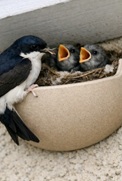
artificial house martin nest cup
Authentic avian cultures, expressed through social behaviour, social learning, and natural nesting practices, are being eroded by human intervention, such as artificial nesting banks and nest cups. This is a casual normalisation of novel ecology which, coupled with the broader argument that ecosystem integrity should be redefined in a human dominated world, is degrading authentic nature and its cultural transmission. The natural world will only persist if we are just observers rather than harmers
My winter bird friends, the turnstones (Arenaria interpres) and purple sandpipers (Calidris maritima) kept me entertained during the winter months, as they fed at low tide amongst the large pile of rocks that sit on the sands immediately opposite the spillway between West Pier and its extension in Whitby (see turnstones feeding). I would combine a visit to those rocks with a count of the fulmars (Fulmarus glacialis) on the nearby sandstone ledges at West Cliff, the fulmars having returned at the beginning of December from their sojourn at sea (1). Whereas in previous years, I had just counted the total number of fulmars on the ledges, I started counting the number of pairs at each location as well, as hopefully an indication of the number of bonded couples that could give rise to chicks later in the year, more of which later.
A wader that swims
While the sandpipers and turnstones, up to five or six of each, did not entirely mix on the rocks, they were often in close proximity, but without tension between them (see photo). Their imperative was to feed for the few hours that the rocks were exposed by the low tide. Importantly for me, they were unconcerned with my presence, an indication of their tolerance and sensitivity to disturbance albeit that I made no sudden moves (2). I was surprised at how often their foraging brought success (see purple sandpipers feeding). Again, in March, I saw and heard with amusement a turnstone turning stones on the low-tide pebble bank in front of the spillway, pulling out and swallowing marine invertebrates whole (see video). I often saw a cormorant (Phalacrocorax carbo) diving and fishing in the waters in parallel to the pier extension. Occasionally, it would hop onto to the rocks and spend some time drying its wings (see video). I would hear a rock pipit (Anthus petrosus) fly in to feed amongst the rocks before I saw it, another bird making use of this opportunity. I also saw rock pipits over on the sandstone cliff, so I assumed that this UK resident nests there in rock crevices, or maybe cavities on the grassy slopes above the cliffs (3).
Both of my winter friends were gone by the end of April, back to their breeding grounds of the High-arctic Canada and Greenland for the turnstones, and eastern Canada, Scandinavia and Svalbard for the purple sandpipers (4,5). My last sighting was of purple sandpipers at the other location where I would notice them, the edges of the rock terrace at mean low water by Saltwick Nab. I would often see them walking through shallow pools as they foraged, even occasionally swimming across when the pool became deeper, a surprise since these birds are waders and don’t have webbed feet (see (6)). It’s a useful skill for this wader, as it can be inundated when a wave breaks over the rock edges. My repeated attempts, however, to capture this phenomenon of swimming never met with great success (see video).
Swooping spring arrivals
Having left last August, the sand martins (Riparia riparia) were coming back while my winter friends were leaving. I had noticed over the winter that new sand lenses had been exposed through erosion on the soft cliffs at Upgang. In addition, of the five nesting colonies in sand lenses from last year, only one had most of its nest burrows undamaged, the faces of those sand lenses having been refreshed by erosive sand slip over the winter. It was intriguing to see what would happen when the sand martins returned – would they use what was left of the old colonies, or dig ones in the new lenses? In late afternoon on the 7 April, I saw five sand martins flying as a group back and forward across the face of Upgang Cliffs. I went back the next afternoon and saw a swooping mass of 30-40 sand martins, converging as a group on each of the new sand lenses, seemingly gripping at nothing, and then moving to the next one (see video). My surmise was that the swoop was collectively checking out the suitability of these new lenses for digging burrows, avoiding either too compact or loose sands (see (7)). It was surprising then how quickly a sand martin nest colony of 20-30 holes was created on a new sand lens – compare these two photos only eight days apart.
I began thinking that this swooping behaviour
and subsequent burrow digging was evidence of a sociality which assured
success of nesting colony development. It would also be how young returnees
benefited in learning from their peers in assessing sand penetrability and
stability, and then observing excavation patterns so that the burrows were not
too close together. The evidence, though, in the literature of the sociality
of this swooping behaviour and colony development of sand martins is poor, but
an abstract from a paper published in 1959 was near to my experience (8):
“Observations were carried out at a Sand Martin colony in a working
sand-pit, where fresh burrows have to be dug each year. Sand Martins arrive at
the breeding pit from migration unpaired, and their social organization is
then at its lowest. Burrow excavation occurs only as the climax to a form of
group display. Digging is communal in character, and the number of burrows dug
is roughly equal to the number of individual birds present. The mounting
excitement and mutual stimulation of the display period induces a climax at
which the birds begin to build nests and lay. This period of display produces
close synchronization which seems to be a necessary condition for the communal
behaviour of the birds during the rest of the breeding cycle”
During those first eight days, the sand martins had created four new colonies, and four from last year were having new burrows dug (see video). Two of those new colonies had been created on the side of a spine that is at the eastern end of a ledge, a vegetated cliff slump that I often climbed up when monitoring its flora (1). I climbed up on a day in mid-April when the sand martins were swooping on a new sand lens that had become exposed just below an older one. As I expected, they moved away at my presence. However, once I had planted myself for coffee on the ledge at a respectful distance, they started to come back, and in large numbers. It was a spectacle - I especially enjoyed when they buzzed around my head, passing so closely to me, all the while chattering away to each other.
By the third week in May, the behaviour had changed. There was not the mass swooping that I had seen earlier. There was still the sociality of the swoop, but the groups were much smaller as they were divided by their choice of colony location. There were also just individuals coming and going at the various colonies. I can’t comment much on pairing – there doesn’t appear to be a visual distinction between sexes. There did, however, seem to be pairs in flight, one behind or to the side of the other. In addition, a bird would land at a burrow opening and seemingly look for another bird to turn up, perhaps a male attracting a female (9). Then, at the end of May, a disaster struck when there was a complete collapse of the sand on a new colony above another ledge. A sand fall there over the winter had opened up a large new lens face, and which was quickly utilised when the sand martins got back. The collapse had taken all of that away, probably up to 30 new burrows in this colony. It was heartening, though, to see that at least three new burrows had been dug, and that the sand martins had reverted to mass swooping across this refreshed sand face, especially in checking the new burrows. My thought was that it was back to the assessment phase. Will they chance it again, or leave it alone? My answer came in early June when only a few more burrows had been dug, nothing like the number that would have been there if it was a serious redevelopment. Moreover, I noticed there was not a huge amount of colony activity at any one location, just a bunch of sand martins to-ing and froing and enjoying the breeze.
It was the end of June before I returned again, and was surprised to find another three new colonies had been developed, again showing how quickly things happened. That made a total of 13 nest colonies compared to the five of last year. I only saw activity at four of them, three of the very recent new ones, and at a refreshed one from last year, all of which were sequentially spaced along the cliff. It made me wonder whether all of the colonies were getting used for nesting. Would they have dug more colonies than they needed? I contented myself that I would just have to wait to see at which colony the multiple faces of sand martin chicks would eventually appear as adults flew in to feed them.
It was at the end of the third week in July that I saw the first small chicks being fed, and I had my question answered – the nest colonies that appeared to have activity were where adults were feeding chicks. I knew from last year that at a later stage of chick development, multiple faces would be seen at the entrances to the burrows, waiting to be fed – the female can typically lay four to five eggs (10). However, at this early stage, the youngest chicks would be immobile within the hole. Thus, I would catch only a glimpse of those with some mobility as they came forward in the hole only to retreat back in after being fed. One reason for this reticence is caution. A carrion crow (Corvus corone) will cheekily perch above a colony causing lots of chatter from the adults, and no faces to be seen. Everything returns to normal after the crow leaves. I doubt the crow will get anything even when the chicks fledge, as sand martins are very agile, fast fliers. A visit on the last day of July saw a familiar pattern of adult sand martins flying low over the shore sand at the sea edge, and over the sea, presumably catching insects before they returned to a nest colony (see photo). It was great fun to be amongst them. There were still not many small faces positioning themselves at the entrances, although some did in expectation. I was sure it’s indicative of a stage of development.
Fulmar breeding season
While enjoying the appearance of the sand martin chicks, it had been an anxious time monitoring the fulmars on the cliff ledges at West Cliff, and waiting to see the first chick there. From my regular monitoring, I had seen peak numbers of around 40 fulmars on the cliff ledges over the months from December to April. The largest number of pairs were 12 during that time, a surprising indication that seemed in line with when I had seen 11 chicks last year (1). There were repeated periods where all the fulmars would disappear for a few days – this was especially marked in the second half of March. I now suspect that this was because the colony would go off and feed as one, as a flock. The number of pairs fell from May onwards, but there still being a presence of over 20 fulmars. Young fulmars spend their first four or five years at sea, before revisiting the colonies where they were born (11). Even then, they will not breed themselves until they are nine years old and reach sexual maturity. This may explain why the total number of fulmars declined after April, since there was no necessity for the non-breeders to remain, but at least they re-established their link with the colony location and experienced a period of communal living on the ledges.
The number of fulmars tailed off markedly again from the beginning of July, down to only 10 on the 22 July. A similar drop happened last year, but I had seen two chicks by mid-July. I went down again two days later and the adult number had dropped to seven, but two chicks had appeared that were unaccompanied by an adult. These fluffy grey bundles were almost adult size so that much of their development must go unnoticed until they have got to the stage where they were big enough to start moving around and reveal themselves. Fulmars do not build complex nest structures, instead laying their single egg on a bare patch of soil on a ledge or in a small gully on the cliff face (12). These small gullies and the vegetation growing on the ledges don’t help with observation. My suspicion that there would be more crouched down in the gullies or behind the vegetation was confirmed when three more appeared over the following six days. The adults reduced to three, but chicks are only tended by an adult for 10 to 16 days after hatching, after which the adult primarily only visits the nest to feed their young (12)
The disappearance of adults leaving their chicks unattended while they feed out at sea probably explains the apparent second drop in adult fulmars observable on the ledges. I was really pleased, then, on the last day of July to observe three of those fulmar chicks being fed, the chick tapping its beak against a returning adult’s beak to encourage it to open and regurgitate semi-digested marine prey and stomach oil into the begging chick's smaller beak, although the feeding was interrupted when another adult fulmar flew in (see video and (13)). There were five adults on the ledges that day, other than parents returning to feed chicks. I took those remaining adults as a sign that there were probably more chicks being watched over until they got larger. In confirmation of that, I went back the next day, and traversed along the sands below the ledges, looking for each fulmar chick identified from previous days. Two of them were still pretty much hidden with one stubbornly refusing to bob its head up to reveal itself. A chick at the end of my traverse looked restless, appeared to be trying to eat grass, kept shifting its resting position from left to right. To my delight it started flexing and flapping its nascent, undeveloped wings that that were still covered in juvenile fluff, a sure sign of progress towards fledging (see video). This chick was at the stage where its parent had abandoned it, and which was usually two weeks before they fledge. I went back to the beginning of my traverse, and noticed that the adult fulmar that had sat at the entrance to a small cave had gone. Sure enough, a new chick was revealed as it came forward in expectation of its parent returning. I also saw an adult fly in to land behind some vegetation, and soon I could just make out another new chick there as it partially revealed itself while being fed. That made a total of seven chicks - I was hopeful of at least two more, and they had appeared a week later when I watched one of them being fed through a screen of vegetation (see video). As with the sand martins further along the coast, the fulmars feign obliviousness to the hordes of holidaymakers below.
House martins: sociality, nesting, and cultural loss
The colony return of breeding age fulmars last December, as well as non-breading progeny from previous years, was evidence of sociality, as is the feeding of fulmars in flocks out to sea (14). They gather in large groups on the water or in the air, especially when an abundant food source is present. In addition, they form large aggregations and rest in rafts on the sea surface when not actively flying. I witnessed more evidence of sociality when I saw house martins (Delichon urbicum) flying over the grassland slopes of West Cliff. I regularly monitor the slopes each year to record the chronology of native wildflowers coming into bloom (15). It was during late April and into May that I started to see a series of house martins regularly flying back and forth low over the slopes, after having returned from their winter in Africa (16). My first thought was that they were sand martins, but they were a larger bird with a white rump and dark upper parts that meant they were house martins. (17). Then from late May into June, I saw the house martins collecting mud from bare earth seepages on the grassland slopes only to use it to build nests under the eaves of houses along the front (see video). Coming up one day in July from noticing sand martins, I saw some house martin chicks being fed. They were sitting on a rain gutter on the opposite side of the road to where their nest was built under the eaves of a house (see photo). I was struck by how fluffy their feet were and discovered that house martins are the only member of the swallow family that have white feathers covering their legs and toes (16).
House martins build their mud nests on a vertical surface from up to 1,000 beak-sized pellets of mud, leaving only a small opening at the top (17). As their common name suggests, these members of the swallow family are so named because the bird's mud nest is usually located below the eaves of buildings. Indeed, the relative frequency by habitat occupied in the breeding season is by far the greatest in villages and towns than it is in coastal areas (18). I have written before that while it is perhaps understandable that our common names like that of the house martin arose after millennia of cultural land use, the misnomers are a lesson in how wild nature became acculturated into an urban existence, and which can therefore be very misleading in terms of its wild origin (19). Having noticed the fluffiness of the white feathers covering the legs and toes of house martin chicks, I now understand how the common name in German came about. It is Mehlschwalbe (20) which translates to flour (Mehl) swallow (schwalbe) presumably as its feet look as though they have been dipped in flour, and so it is another anthropomorphising.
I noted in the article about common names that I had seen in 2017 some house martins that were nesting in the small overhangs of the rocky coastal sandstone cliffs of Nolton Haven, a cove on the S Pembrokeshire coast in Wales (19). I didn’t realise how significant a sighting that was at the time, but it did make me consider that they should instead be called rock martins to signify the natural origin of the wild location of their nests. House martins are known to use a natural sea cliff or rock face where there may be a colony (21) and it made me look with new eyes at the sandstone faces of West Cliff where there did seem many opportunities to use shaded overhangs for building nests, but they don’t. Information on house martins nesting on cliffs is very sketchy, the problem being that there appears to have been a sharp decline, leaving a vanishingly few known places where these birds do nest on cliff faces rather than houses. This was revealed after a call went out in 2021 from the British Ornithologist’s Union asking for records of sightings and nesting history, the data being turned into a map showing currently active nesting locations, and historic sites no longer active (see the map in (22)).
There was only one inland location on the map, which was at Malham Cove, a 70m high, large, crescent-shaped limestone cliff face near the village of Malham in N Yorkshire - I have seen peregrine falcons (Falco peregrinus) nesting on the cliff there (and see (23)). As for house martins, a Country Diary article from 2023 observed that climbers of this scarp posted warnings on climbing forums to keep from disturbing the breeding house martins on the frequently affected routes (24). The rest of the nesting locations were on cliffs or in sea caves around the coast of Britain. The nearest to Whitby was 33 miles S along the coast at Selwick’s Bay on Flamborough Head, an 8-mile chalk promontory on the East Yorkshire coast that has 122m high white cliffs ((25) and see the nest sites in (26)).
As well as Nolton Haven (see above) they also nested on the sandstone cliffs and sea caves to the south of Ceibwr Bay on the N Pembrokeshire coast in Wales (27). There is a video clip from 2011 of nature observer Iolo Williams sitting on a cliff top over the bay explaining that he too had wondered where house martins would originally have nested, and then goes on to show the cliff face locations ((28) and see also the video in (29)). Williams noted that there may only be six locations in the whole of Wales where they still used natural sites. According, though, to the recent mapping of cliff nesting sites carried out a decade after that video (see above) three of those on the Welsh coast are no longer active, with the only other active site being on the Vale of Glamorgan coast, possibly the limestone cliffs at Lavernock Point near Cardiff (30). There were reported to be 4,000 nesting pairs of house martins in Pembrokeshire alone (27). Thus, the speculation that 99% of the breeding population were highly dependent on buildings through making their mud nests, or utilising artificial nest boxes, high-up on walls beneath over-hanging eaves, was probably not an exaggeration.
There were only five other locations of cliff nesting sites in Britain shown on that map, one on the SE coast of England (maybe on the chalk cliffs of Dover) three on the east coast of Scotland - one somewhere on the cliffs of the E Lothian coast; at Seaton Cliffs Nature Reserve along the Arbroath Cliffs in Angus, where the house martins build their mud nests beneath the natural red sandstone overhangs (31) and on the Aberdeenshire coast, possibly at Fowlsheugh cliffs (32) - and finally one in the Orkneys. Given this overall paucity of use of cliff nesting sites, it means that most house martins grow up without the heritage of their ancestors - they have lost a significant part of the socially learnt behaviour of where their mud nests are naturally located, an incomplete cultural inheritance (and see (33)). You may consider this an intractable loss, but must we make the cultural inheritance even worse by providing house martins with artificial nest boxes?
The artificial nest cups for house martins, as they are often called, are made with a variety of materials that includes woodstone/woodcrete (a mix of concrete and wood fibres)(34,35) fired terracotta (36) and moulded resin/concrete (37). The cups are attached to a backboard that can be fixed to a wall, and they invariably come with a roof board over the cup to simulate the shade of an eave. The charity House Martin Conservation UK & Ireland calls the installation of ready-made nest cups an “important part of house martin conservation” (38) the largest bird charity The Royal Society for the Protection of Birds says that by “putting up a House Martin nest cup you can help support these summer migrants by offering them a place to nest” (36). In addition, there was a news report last December that the Hampshire House Martins Project was offering free nest cups that “save the birds time and energy compared to building their own mud nests” (39) and this was echoed on the Hampshire House Martin Project website where it says “Sometimes it is difficult for them to find soft mud from which to build their nests. Their nests stick less easily to modern plastic soffits and may fall off, killing eggs and young and wasting weeks of time and nest-building effort…. Some of the artificial nest cups we've fitted are already in use. They save House Martins valuable time, make the nests more robust and should boost breeding success” (40). Does it seem like a semi-domestication?
Artificial nest cups and cultural integrity
When I first wrote about the sand martins at Upgang Cliffs, I noted that the drive to maintain an inland breeding population against declining opportunities for natural colonies was leading to more and more artificial nesting banks, hailed as saviours but without thought of the long-term consequences for the species (15). I asked, do we want sand martins to become dependent on artificially created nesting colonies? In the extreme, what happens if sand martins lost their instinct of how to burrow for themselves so that their natural nesting sites in places like the soft cliffs that I watched were no longer used? It seemed to me that this human mastery diminished the intrinsic value of a wild species. Having now recognised the importance of cultural transmission in the perpetuation of social species like the wolf (33) I see the sociality of sand martins, the learnt behaviour and information being transmitted from parent to offspring, especially about nest colony development, as also being evidence of culture. The burgeoning artificial nesting banks are thus a break on authentic cultural transmission in sand martins. It is my hope, though, that the Upgang Cliffs may long provide sand lenses for colonies, and in so doing perpetuate the culture of sand martins. I would make the same argument about the sociality of fulmars, an ocean-going species whose culture makes no use of inland locations. Their year-by-year use of the sandstone ledges and gullies at West Cliff will persist as long as we have the sense not to continue to degrade the marine environment that feeds them (15).
Consider now the house martin, a bird that also exhibits sociality when searching for and foraging mud, and in forming small colonies of nests. It is alleged that they were just known as martins until the beginning of the 1800s, but then started making use of buildings so that their common name changed (41). I’m not sure that timing is necessarily true. Carl Linnaeus, who formalised the binomial Latin system of naming species, had Hirundo urbica in a 1758 edition of his Systema Naturae (42). The first part Hirundo relates to the swallow family (Hirundinidae) of which the house martin and sand martin are members, but which for house martin was later changed to Delichon. The second part of the species name, urbica, indicates “of urban location”. In addition, under the entry for habitat in Europe, Linnaeus had “to the walls under the roof” (ad parietes sub tecto). Unsurprisingly, Linnaeus notes the habitat for sand martins as "with steep sandy hills, serpentine sand" (collibus arenosis abruptis, soramine serpentino). It may be impossible to trace back to when the first house martin sought the convenience of nest building away from the exposure of a cliff face, whether inland or coastal. That both cliff face locations are still used today is evidence of a continuing authentic cultural transmission for the species, but the small and declining numbers that do so suggest that there may not be any mixing between the two different cultures of cliff face and house wall.
I can’t see how or whether we could intercede on the latter. We should not, however, presume that our provision of artificial nest cups is in the best interest of the species. A recent paper in the journal Learning & Behavior makes that point (43). It moves beyond traditional human-centric conservation arguments that focus on the instrumental value of animal cultures (such as supporting species survival or ecosystem services) and even beyond intrinsic value (cultural diversity as a component of biodiversity) and makes the strong argument that “animal cultures matter first and foremost because they matter to the animals themselves”, that culture matters because it reflects the shared way of living that a self-determining community has created for itself, and that harms to animal culture are direct harms to animal wellbeing. The authors go on to argue those advocating for animals should articulate the ethical arguments for protecting animals’ ability to continue their practices of culture building through social learning as a necessary part of their flourishing, and ask the question whether protecting animal cultural diversity itself should become a new conservation goal? I would suggest that this plays into our incorrigible need for gratification in ensuring the continuing presence of species, as judged by number counting, through provision of such as management actions, or artificial nest cups in the case of house martins, and in so doing mask what may be the underlying reason for decline, but more seriously in damaging authentic animal culture that is vital to the animals themselves.
Just observers rather than harmers
I never expected to become a bird watcher. I prefer anyway to call it a bird noticer because I don’t set out just to collect a list of sightings of different bird species. Instead, I notice the behaviour of birds that live free and authentic lives and what that tells me about their natural lives, social learning and, now that I am conscious of it, their culture and its intergenerational transmission. While plant species aren’t sentient, they do exhibit community associations, self-assemblies that I find fascinating when unfettered by human land use, such as those local to me, the ancient woodlands of Cock Mill and Larpool (44) the grassland slopes of West Cliff (15) and the ledges on Upgang Cliffs (1) all of which are supportive of those species that are sentient. If I could endure the dusk and darkness, it would open me up to noticing the behaviours of those species that I mostly only have signs of a local presence, such as badgers, roe deer, rodents, bats and owls. It is in those unfettered behaviours that all those species reveal their wild nature and the culture that informs it. It is the natural world that persists if we are just observers rather than harmers. What concerns me is this casual normalisation of novel ecology through artificial nest cups, and which is writ large by loud voices that argue that the way we define ecosystem integrity is outdated in a world reshaped by humans, that the authentic nature that the past gives voice to should be disregarded in what is fundamentally an orchestration of nature at human behest (see for instance (45-47)). I will need to return to this aberration of novel ecology later.
Mark Fisher 10 August 2026
(1) Noticing nature, Self-willed land 6 December 2025
www.self-willed-land.org.uk/articles/noticing_nature.htm
(2) Goodship, N.M. and Furness, R.W. (MacArthur Green) Disturbance Distances Review: An updated literature review of disturbance distances of selected bird species. NatureScot Research Report 1283
(3) Rock pipit (Anthus petrosus) Songbird Survival
https://www.songbird-survival.org.uk/songbirds/rock-pipit
(4) Purple Sandpiper (Calidris maritima)
https://datazone.birdlife.org/species/factsheet/purple-sandpiper-calidris-maritima
(5) Ruddy Turnstone (Arenaria interpres)
https://datazone.birdlife.org/species/factsheet/ruddy-turnstone-arenaria-interpres
(6) Purple Sandpiper (Calidris maritima) Animal Diversity Website
https://animaldiversity.org/accounts/Calidris_maritima/
(7) Çelik, E., Durmus, A., & Jokimäki, J. (2023). Sand-Related Factors Influencing Nest Burrowing Potential of the Sand Martins. Animals, 13(22): 3463
https://www.mdpi.com/2076-2615/13/22/3463
(8) Hickling, R. A. O. (1959). The burrow‐excavation phase in the breeding cycle of the sand martin Riparia riparia. Ibis, 101(3‐4): 497-502
https://onlinelibrary.wiley.com/doi/abs/10.1111/j.1474-919X.1959.tb02407.x
(9) Riparia riparia, Animal Diversity Web
https://animaldiversity.org/accounts/Riparia_riparia/
(10) Productivity and nesting, Sand Martin (Riparia riparia)
https://www.bto.org/learn/about-birds/birdfacts/sand-martin
(11) Fulmar (Fulmarus glacialis) BTO
https://www.bto.org/learn/about-birds/birdfacts/fulmar
(12) Northern fulmar - Fulmarus glacialis, ADW
https://animaldiversity.org/accounts/Fulmarus_glacialis/
(13) Fulmar Feeding, David Steel, Isle of May National Nature Reserve, NatureScot 4September 2020
https://isleofmaynnr.wordpress.com/2020/09/04/fulmar-feeding/
(14) Fulmar, Isles of Scilly Wildlife Trust
https://www.ios-wildlifetrust.org.uk/fulmar
(15) A natural life – the self-will of existence, Self-willed land August 2024
www.self-willed-land.org.uk/articles/intrinsic.htm
(16) House Martin (Delichon urbicum) RSPB
https://www.rspb.org.uk/birds-and-wildlife/house-martin
(17) House Martin, Swift or Swallow? How to tell the difference, RSPB2
(18) House Martin (Delichon urbicum) BTO
https://www.bto.org/learn/about-birds/birdfacts/house-martin
(19) Rumination, mindfulness and Awe Walks, June 2017
http://www.self-willed-land.org.uk/articles/awe_walks.htm
(20) Western House Martin, Delichon urbicum, Avibase -The World Bird Database
https://avibase.bsc-eoc.org/species.jsp?avibaseid=30FEC6BE132E1224
(21) Northern House Martin (Delichon urbicum) DataZone, Birdlife
https://datazone.birdlife.org/species/factsheet/northern-house-martin-delichon-urbicum
(22) Are these the most northerly cliff-nesting House Martins in the UK? David @ The HALL of EINAR, 29 September 2021
(23) About peregrines at Malham Cove, Yorkshire Dales National Park
(24) Country diary: The climbers here know the house martins best, Richard Smyth, The Guardian 18 August 2023
(25) Country diary: where did house martins live before there were houses? Mark Cocker, The Guardian 5 October 2021
(26) Josh Smith, Facebook post, UK WILDLIFE PHOTOGRAPHERS 2 July 2026
(27) House Martin – 2003-07 breeding, Pembrokeshire Avifauna
https://pembsavifauna.co.uk/2020/06/01/house-martin-2003-07/
(28) House martin nests – clip from Iolo's Secret Life of Birds, BBC 31 March 2011
https://www.bbc.co.uk/programmes/p00g3nj8
(29) Stephen Roberts, Facebook posting, House Martin Conservation UK & Ireland 25 June 2026
(30) Site map, Lavernock Point, Penarth, Vale of Glamorgan, The Wildlife Trust of South and West Wales
https://www.welshwildlife.org/sites/default/files/2022-03/Lavernock-Point.pdf
(31) Seaton Cliffs, The Scottish Wildlife Trust
https://www.swtdundeeangus.org.uk/seatoncliffs
(32) Fowlsheugh, Crawton, RSPB
https://www.rspb.org.uk/days-out/reserves/fowlsheugh
(33) Lessons from niche partitioning: rethinking human obligations in wolf coexistence, Self-willed land March 2026
www.self-willed-land.org.uk/articles/niche.htm
(34) WoodStone House Martin Nest Box Cups – Double, CJ Wildlife
https://www.birdfood.co.uk/woodstone-house-martin-nest-double
(35) Single House Martin Nest Cup with backboard and roof, Nest Cup Box Ltd
https://nestcupbox.com/product/single-house-martin-nest-cup-with-backboard-and-roof/
(36) House Martin nest cup, RSPB
(37) Eco House Martin Nest, nestbox company
https://www.nestbox.co.uk/products/eco-house-martin-nest
(38) Artificial nest cups, House Martin Conservation UK & Ireland
https://housemartinconservation.com/artificial-nests
(39) House martin nest cups offered to combat decline, BBC News 14 December 2025
https://www.bbc.co.uk/news/articles/c87lyqw2eleo
(40) Hampshire House Martin Project
https://hampshirehousemartins.org.uk/
(41) House Martin (Delichon urbicum) Songbird Survival
https://www.songbird-survival.org.uk/songbirds/house-martin
(42) Carl Nilsson Linnæus (1758) Systema naturae per regna tria naturae, secundum classes, ordines, genera, species, cum characteribus, differentiis, synonymis, locis, 10th Edition Volume 1
https://books.google.co.uk/books?id=E20ZAAAAYAAJ&pg=PA192&redir_esc=y#v=onepage&q&f=false
(43) Fitzpatrick, S., & Andrews, K. (2026). Animal cultures matter for conservation, but also to animals. Learning & behavior, 54(1): 163-179.
https://link.springer.com/article/10.3758/s13420-025-00700-4
(44) The ecological integrity of ancient woodlands, Self-willed land May 2025
www.self-willed-land.org.uk/articles/cock_mill_larpool.htm
(45) Harris, J. A., Bullock, J., Pettorelli, N., Perring, M., & Mercer, T. G. (2024). Novel ecosystems: the new normal? British Ecological Society
https://www.britishecologicalsociety.org/content/novel-ecosystems-the-new-normal/
(46) Svenning, J. C., McGeoch, M. A., Normand, S., Ordonez, A., & Riede, F. (2024). Navigating ecological novelty towards planetary stewardship: challenges and opportunities in biodiversity dynamics in a transforming biosphere. Philosophical Transactions of the Royal Society B: Biological Sciences, 379(1902), 20230008
(47) Svenning, J. C. (2026). Redefining ecosystem integrity for an Anthropocene biosphere: a process‐and lineage‐based framework for restoration. Restoration Ecology, e70390
https://onlinelibrary.wiley.com/doi/full/10.1111/rec.70390
url:www.self-willed-land.org.uk/articles/house_martins.htm
www.self-willed-land.org.uk mark.fisher@self-willed-land.org.uk